The Memoirs of Bob Veazey
The trip to Korea from Travis AFB, CA via Japan included scheduled stops at Hawaii and Wake Island. The DC-6 just didn't have the range to travel much further on each leg. The DC-6 was also a fairly slow aircraft and as I recall, it took about eight hours to reach Honolulu. There was a brief stop for refueling, giving only about an hour to stretch our legs and allow me to take a couple of pictures with my little Bolsey camera of the control tower with the word "Aloha" prominently displayed. Our flight to Wake Island was a little shorter than from California to Hawaii, and we arrived in the late afternoon. Wake Island still displayed the effects of the war. It was just a crescent of sand and coral with a runway on one leg of the crescent. Behind the operations building (a shack), there was a Japanese mini tank, and when we were bused around to the other end of the island to a mess hall, we saw numerous beached and partially submerged ships. Signs on the beaches warned that there were unexploded mines ther,e and the remains of gun emplacements were evident. After a light meal, we were bused back to the other side, boarded the DC-6, and took off for the overnight flight to Japan.
We arrived at Haneda Airport in the early morning and were bused to "FEAMCOM Area B," a transient administration center, located outside of Tokyo. The first thing I noticed was that there was a strange odor in the air. It was a "wood smoke" kind of odor, but also with a hint of incense and perfume. Arriving at the center, we were given briefings on the customs of Japan, warned about sexual diseases, and told to stay in touch with the transport office for word of further travel. We were billeted in large tents with wooden sides and floors. I had been in the same clothes for almost three days, and the first thing I wanted was a shower. Told that the shower was in a metal building just down the street, I gathered up my "dop" kit and a towel and headed out. Entering the building, I saw a row of showers; no stalls. I took off my clothes, laid them on a bench, and turned on the hot water--heaven!! Then--in walked a Japanese woman who proceeded to disrobe (bowing to me and mumbling something I didn't understand) and proceeded to lather up!! Welcome to Japan!!! I quickly rinsed off, dried with the towel, dressed, and fled!!
The procedures were the same as at Camp Stoneman: be there to check in for travel orders. If no orders, same routine--go to the club, play cards or read, and just relax. We had to surrender all of our U.S. money in exchange for military "script", however, I held out the silver dollar Len Whann gave me. A couple of us met a Captain who had been in the RAF as well as the USAF, and he had been in Japan before. He acted as tour guide and we took a train into Tokyo where he showed us the sights and briefed us on haggling for things to be bought. We saw the emperor's palace, the famous Imperial Hotel, and the building where General Mac Arthur ruled until
President Truman fired him. After a few days my orders came through, and I was put on a train to southern Japan. On the way we passed through Hiroshima, but really couldn't see any atomic bomb damage. We stayed overnight at Iwakuni Air Base, home to a Royal Air Force unit. The next day I got on a C-46 for a flight to K-1 Air Base on the southern tip of Korea. There were sandbagged foxholes and gun emplacements scattered around the runway area, and it appeared that we had really reached the war zone. After a short stop, the C-46 proceeded to K-13, Suwon Air Base.
The single runway at K-13 was over 10,000 feet long and paved with asphalt. The taxiways were pierced steel planking (PSP), which was very bumpy to taxi on. The base was very large, with the 51 st Wing, flying F-86s, on the west side of the runway and the 8th Wing, flying F-80s, occupying the east side. The control tower for the base was located on the 8th Wing side of the base. I noticed that the F-86s all had a black checkerboard design on the vertical stabilizer, and that the F-80s had stripes on their vertical stabilizers, which ran from the lower leading edge and sweeping up to the top. I found out that each of the squadrons of the 8th had a different stab color. The 35th Squadron had blue stab stripes, the 80th yellow, and the 36th red. The squadrons each also had an insignia, which the pilots wore on their jackets and on ball caps of the squadron color. It was the custom to mark the brim of your hat with a small line for each combat mission flown. This made it easy to spot the "old heads" (more experienced pilots) from the "new heads." There was also a squadron of F-94B all weather fighters, the 319th Fighter Interceptor Squadron, based at the north end of the 8th Wing side. They rarely flew combat missions, however, and mainly flew defensive sweeps over friendly territory at night.
The arriving replacements were assigned to temporary living quarters in the Replacement Training Unit (RTU) area. Living quarters at K-13 were Quonset huts, those rounded top metal buildings developed during the war. The morning after arrival we began classes in the "Little Jet Schoolhouse," as the building was called. We were briefed on the combat situation, the call signs currently in use by the area radar controllers, what to do if hit during a mission, and the type of formation flown by the 8th Group. Of course, there was also a refresher on F-8OC engineering.
My first flight in Korea was on 13 August in a "T -Bird" and the instructor, a pilot who had completed his 100 missions, conducted a tour of the local area. He demonstrated the use of the call signs and the procedures with the radar controllers, and finally let me shoot a couple of landings. The same day I checked out in an F-80C and made a personal tour of the local area and shot more landings. On the 14th, we practiced some four-ship formation flying in the local area, dropped bombs and fired the machine guns on the Suwon Range, basically a small island off the coast and in the Yellow Sea.
On the 16th we flew two combat missions, that is, we flew over the "bomb line", which is what the line between the North and the South was called, and dropped bombs and fired machine guns against the enemy. The area we flew over was the Haeju peninsula, and we were not fired upon by ground fire, that is, as far as I knew. This was also an opportunity to get familiar with identifying features on the ground. This included a lone large smokestack that hundreds of pilots had tried to knock down with bombs, rockets, and machine guns--but there it stood!! Another significant checkpoint was a lake shaped like a butterfly. Most missions conducted to the west side of Korea used the "butterfly lake" as the initial point for navigation. On these flights we simulated "breaking" as if we were attacked. Rather than the familiar "finger four" we used in gunnery school, we flew essentially a line abreast spread formation, which provided more defensive options. A third combat mission was flown on the 17th, along with a T- Bird flight for instrument training and all weather approach procedures for K-13. With the completion of the three combat missions, we were graduated from RTU and moved into our assigned squadrons.
During the initial combat missions I was impressed by the fact that nothing seemed to be moving within the North Korean territory. This was in contrast to the territory south of the "bomb line", where there were personnel and vehicles in plain view. Airfields in the North were absent any visible aircraft and appeared to be deserted. All of this was due to the standing orders that called for bombing and strafing anything that moved. This order included ox carts and personnel. There were several instances where a pilot strafed a person with an "A frame" on his back, which exploded when hit by the bullets. The North Koreans used any form of transport they could to move war materiel to the front lines, and our job was to prevent this traffic.
My assignment was to the 36th (red tail stripes) Squadron. The insignia was a ferocious looking beast, officially the "Flying Fiend", but what we called "The Pukeing Pup". The 36th Squadron dated from the 1920's and had a long history of outstanding performance. All of the pilots in the 36th Squadron wore red scarves with the "Pup" insignia and, in most cases, the pilot’s name embroidered on it. I had another one made and sent it to Joanie. We also had another more elaborate squadron insignia that most of us had sewn over the right side of our jackets. This insignia is shown below. Our Operations Building had a prominent sign on the roof.
The 36th Squadron was comprised of four flights; Mike, Uncle, Queen, and Victor. The move to the squadron landed me into the "Mike" Flight Quonset, which would be my home for the next eight months or so. The Mike Flight patch featured a bulldog-like face munching in on railroad tracks. Flight members wore this patch on our left chest. After a little while, I painted a round disk with our insignia on it, and posted it on our front door. Each member of each flight had an area assigned for "living" quarters within the flight Quonset, which was a space of four feet by eight feet (one sheet of plywood flooring). In this space each flight member could place a folding camp cot topped with an air mattress and several blankets checked out from supply. Sheets --well, you could buy them from the Base Exchange, along with a foam filled pillow. A table and chair could be obtained from a Korean worker on the base, who would
fabricate what you wanted using plywood gleaned from packing crates. Another "new head", Ward Schramm, and I combined our allotted areas so that with our "beds" at the outer limits of our area, we therefore had a more generous "living" area, which we "populated" with tables and chairs built by our friendly Korean carpenter. We had electric outlets for reading lamps and a radio, if you had one. Each flight had a Korean houseboy and the officers living in each Quonset each pitched in to pay him. Our houseboy’s name was "Choy". He would wash our clothes and sweep out the Quonset. We supplemented his pay with food and candy that we could buy at the Base Exchange. Those of us who didn't smoke frequently gave him cigarettes, which we suspected he sold on the black market, because he seemed to appreciate them more than anything else. There were sandbagged slit trenches between each Quonset that were to be used in the event of an air raid. There were five Quonsets for the 36th Squadron; one for each flight and one for the "head shed", the commanding officer and his staff, which included the Flight Surgeon, Captain Leep.
Off to the side was situated a weapons carrier with quad 50 cal. machine guns that could be manned during an air raid. The major air raid defense was provided by the Army with heavy anti aircraft guns located in the hills around the base. Meals were taken in a central officer's mess hall and we had another building used for an Officer's Club. Latrines were very basic: a small building with boards that had round holes located over 55 gallon drums. The drums were emptied on a somewhat regular basis by Korean laborers, who thought that the Americans were crazy for putting paper in that good fertilizer!! Oh, by the way --it was "bring your own" toilet paper!! Urinal type latrines, merely ditches with a privacy wall, were scattered around the Quonset areas.
The Flight Commander of Mike Flight was Captain Cal Jassmann, who had been an airline pilot before being re-called to active duty for Korea. There were about 15 men in our Quonset and all but one or two were pilots. We had our squadron armaments officer, Lt. Hickman, bunking with us. We pilots frequently referred to him as "miserable ground pounding" Lt. Hickman. There was a weapons carrier used to transport the pilots from the living area to the flight line and our 36th Operations building, which was at the south end of the base's flight line. If you missed the "beater" as we called that vehicle (for obvious reasons), you had to walk, a distance of about a mile. The "beater" was a "drive your own" arrangement, no schedule, just take it when it was available. Adjacent to 36th Ops was our Flight Ready Building, where we spent our time between flights. This was also where our flight gear, helmets, parachutes, "g" suits, survival vests, and escape and evasion vests, were kept. Here also was the status board where missions were posted along with aircraft assignments. There was a coffee and tea bar, tables for card playing (hearts was big) and, of course, the usual "fighter pilot's" game--ping-pong. Dress on the base was very casual. Most days we wore flight suits and red ball caps and, of course our red scarves decorated with the squadron insignia. When not on flying duty, khaki pants and shirt replaced the flight suit.
I should note here that we had no special survival clothing issued until after the first months of 1953, and flew overwater that winter, where the survival time was measured in minutes if one were to have to bail out and land in the water.
Combat missions were generally one of four types. The usual mission was "pre-briefed" with a flight of four briefed to attack a specific target. A second type was a "JOC" (Joint Operations Command) mission, usually flown by a flight of four who had been on alert and which was directed at a target called in by, usually, a front line observer, or a reconnaissance aircraft. A third type was a pre-briefed mission flown in squadron, (12 aircraft) or on rare occasion’s group (48 aircraft) strength. The forth type of mission was a "late light recce" where the flight of four would take off just before dusk, bomb a road with a partial load to cut the road, fly north for 15 minutes or so and then return to bomb and shoot up trucks backed up at the road cut. An "old head" regular pilot usually flew lead on the four ship missions, while flight commanders led the larger formations. After all missions there was a debriefing of each flight member by intelligence personnel.
Our F-80C's normal armament load was two 1,000-pound bombs and 1,800 rounds of 50 caliber bullets, 300 rounds in each of the six guns. We also carried two wing tip "Misawa" style (under slung) tanks, each holding 165 gallons of fuel. Alternate loads were four 500- pound bombs, two 165-gallon napalm tanks, or four (4) High Velocity Aerial Rockets (HIVAR). On some special missions we carried four 1,000-pound bombs and no tip tanks. These missions were usually against grass strips used by "Bed Check Charley", PO-2 biplanes which putted around tossing out grenades or small bombs at night. Our bombs on these missions were equipped with a combination of instant and time delay fuses; some with delays of up to 12 hours or more. The idea was to "discourage" the workers trying to repair the bomb damage. On napalm missions, we were usually loaded with "max 50s"--3600 rounds--for our machine guns so that we could strafe during our runs. We had to fire off at least half of these rounds to lighten the nose so that we could raise it during landing.
These heavy loads, combined with the stresses of pulling out of steep bomb runs, caused wrinkles in the fuselage wing fairings, which eventually resulted in cracks. After many repairs the fairing needed to be replaced. In addition, the wings always seemed to "droop" when the aircraft was on the ground and loaded!! In the F-80 we flew a very steep, almost vertical dive that made us a small target for the enemy's anti-aircraft guns. This was in contrast to the shallow dive used by the F-84s in order to avoid ripping their wings off.
On August 21 I flew a "local" flight with my new squadron, and my fourth combat mission, a JOC mission, the target was a road with vehicles near the East coast. This was unusual, because while activity on the ground was common south of the "bomb line", movement of vehicles or personnel north of the line was rare, at least during the day. On this mission I experienced my first ground fire --40 mm automatic weapons "golf balls" (bright balls of fire streaming up at us).
On the 22nd I flew my fifth combat mission. Cal Jassman led, and we were diverted from our pre- briefed mission because of weather and bombed some buildings west of Pyongyang, the North Korean capitol. When I landed and taxied into the sandbagged revetment, I was met by our squadron adjutant and the chaplain, who informed me that Joanie had suffered a miscarriage.
The word had come via the Red Cross, and I was, of course, devastated. I could only think of how badly Joanie felt. We had been so happy that she was pregnant. I knew that I had to carry on, and when our mail finally caught up we consoled each other as best we could. I tried to write to Joanie every day, and she did the same. The mail, however, was frequently delayed and messages often crossed. I had to be careful about what I wrote, as our mail was subject to censorship; although not every letter was opened. I took pictures of everything I thought would be of interest. I used Kodachrome and sent it to Hawaii for processing, with Joanie's as the return address. After viewing them she returned them to me so that I could judge how my "technique" was doing.
My sixth mission was flown on August 27th and was my first on the front lines. On this one I really experienced ground fire--both golf balls and heavy stuff that burst with a flash of fire and a clump of black smoke!! This mission was near Kumhwa and Papa San Mountain, where fierce ground fighting had been raging for weeks. In my excitement and in deteriorating weather, I forgot to arm the bomb release switches. The target was positions on the top of the middle of three hilltops, with U.S. Marines on the southern most hill. The T -6 Mosquito controller cautioned us to be sure and not drop on their hill! When I pulled out without dropping my bombs, I circled up and around for another pass. I was somewhat disoriented, and when I made my run, I hit the northern-most hill. The controller was ecstatic--he shouted over the radio--"Great strike--they were all out in the open watching their buddies get hit (on the middle hill) and you really blasted them"!! However, I lost the flight and Lt. Dunn, the lead, told me to go home on my own. The weather began to close down, and I had to go on instruments. I was immediately in trouble!! The main compass was not working, and the standby compass had not been checked for over five years. The radio compass, tuned to the K-13 beacon, was swinging one way and then the other-- the Commies were either jamming or using a powerful transmitter on the same frequency--something they did regularly!! I finally set my "parrot" (Identification, Friend or Foe-IFF-) to "emergency" and the radar controllers guided me south until I was near K-13 where I let down on the beacon, now stronger, and landed. Note that five days passed between these latest missions. As I recall, part of this was because of weather, but in part was also due to scheduling.
The success of we fighter-bomber pilots on front line support depended to a great extent on the guys flying the T-6 Mosquito and light planes spotting and marking targets. Sometimes they fired smoke rockets to mark targets, and other times they directed artillery batteries to mark targets with "willy peter" (white phosphorous) shells that exploded with a burst of white smoke. Those spotter pilots flew around over the lines at altitudes below 10,000 feet, dodging flak and small arms fire day after day--brave guys! !
We flew a Group strength (48 A/C) mission on 29 August to bomb a power plant complex in Pyongyang. The sight of all those aircraft winging north was really impressive. This was a "max effort" strike and included the F-84 Groups based farther south at K-9 and K-2, (Kunsan and Taegu) and Marine Corps Panthers. Coordinating this strike was a real chore for the group and squadron leaders.
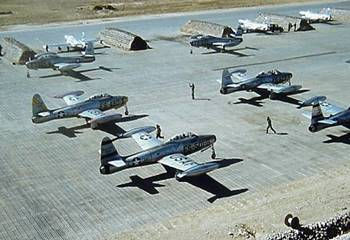
While on our bomb run we found that the South Korean Air Force flying F-51s was also involved!! They were making machine gun firing passes well below us and we ended up dropping our bombs between them, and swerving to avoid them!! This picture shows how the F-80s are lined-up ready for such a mission.
The next day I flew a JOC behind-the-lines mission against troop concentrations and was led by Captain Cal Jassman. The other flight members were two experienced pilots; Mark and Therkleson.
On 5 September, I was standing by on JOC alert with Lieutenants Carpenter, Mark, and Therkelson, shown in the pictures below taken for the Base Public Information (PIO) Officer.
We were sent north in response to a report of a train in the open about 10 miles south of Sinanju. "Therk" led, and I flew #2 on his wing. This rail line was heavily defended, but trains were always a prime priority. Sinanju was pretty far north, and JOC missions rarely had top cover. While the MIGs were always a threat, we seldom saw them, and we were all confident that we could handle them at our operating altitude, usually below 12,000 feet. As a matter of fact, we F-80 "jocks" could easily handle F-86s who tried to bounce us on the way to the Suwon Gunnery Range -- something the 4th Wing ("The Mig Killers"- -so called) new heads tried to do.
The mission was really successful, and in spite of some pretty intense automatic weapons fire, we scored four rail cuts and over twelve loaded railcars destroyed. I was credited with one cut, three cars destroyed, and damage to other cars. We were eventually each to receive a special Air Medal for this, my tenth mission.
The next day we flew a squadron mission (12 aircraft) to a factory complex north of Wonson on the East coast. Col. Grey, our Squadron C.O. led the squadron with Therk on his wing, and I flew #4 on Mark’s wing. We blew up a number of buildings and saw "secondary" explosions, indicating that there were explosives in the buildings.
To support our flying of missions, we had to depend on the ground crews who maintained our aircraft and loaded them with bombs and ammo. They frequently had to work overnight after a busy day of missions to insure that we would be ready for the next day’s operations. The pictures below show a nighttime bomb loading, and flak damage on an F80 that would need to be repaired before the aircraft could fly again.
The missions continued on a fairly regular basis, with a mix of both pre-briefed and JOC missions. On one mission we were scheduled to bomb boats at the mouth of the Yalu River. Cal Jassman led and I flew #4 on "Hezzie" Dunaway’s wing. We separated into elements to hit the boats, and Hezzie, in spite of orders, circled over Sinuiju and down the center of the Yalu. Antung airfield was visible on the shore of China, and I saw the Migs taking off, but they were heading for the F-86s flying high above us. By the way, we did get a couple of hits on some boats.
In between missions I had a tour of the radar site on a hill north of Seoul, the South Korean capitol. I noted that there were essentially no paved roads between two of the largest cities in the country. The picture at left (sic. below) shows me on "Radar Hill", where "Dentist", our friendly controller was located. We talked to him on every mission.
One afternoon, those pilots not on a schedule were trucked over to the 51st Wing side of the base to see a demonstration of a downed pilot rescue technique. Soon after we arrived a "Gooney Bird" flew over and a package was dropped out on a small parachute. When the package hit the ground a bystander ran out and opened it. Taking out the contents he assembled two poles and supports and stretched a line between the tips of the poles. We saw that this line was actually a loop with the lower end attached to what appeared to be a parachute harness.
After putting on the harness, the man sat down about 25 feet in front of the poles with his back to the poles and hunched over. In a few minutes the Gooney flew in really low with a hook-equipped pole hanging out the left aft side door. The hook snagged the line on the poles and the man was lifted off the ground and eventually boarded into the C-47. At a briefing that follows we learned that the system had been used to pick up agents in North Korea and that a number of pilots had also been rescued. I told my friends that this looked familiar, like the system used to pick up mail at DuPont Airport in Wilmington. Little did I know that one day I would be intimately involved in similar systems? In later years I found out that the guy picked up that day was Harry Conway, who eventually worked at AAE, and was instrumental in the development of the air-to-air recovery of parachute borne packages.
I flew a total of 14 missions in September. One of these was a Squadron (12 aircraft) napalm mission against a suspected command post in a village. During the attack I could see people running away. We came in fast and low with machine guns blazing until we dropped our napalm tanks. Since we followed others in on the attack I hit the ignition switch approaching the target, to insure that I would not flame out in the smoke already enveloping the village. I was able to get a recce photo from one of our front line support missions and it appears at right. We received credit for the destruction of a number of personnel shelters, and presumably their occupants. We usually had an opportunity to see the results of our missions a few days after we flew them, but it was difficult to get one to keep.
Near the end of September a flight of 4 from Mike Flight flew south on a training mission to the Nakton Gunnery Range, usually used by the F-84 outfits at Taegu (K-2). The plan was to fire on the range, refuel and re-arm at K-2, fire on the range again, and fly home. One of our flight (can’t remember who!) blew a tire on landing, so we had to RON (remain over night) until a replacement could be installed. This gave us a chance to catch up with friends like Rog Warren, Sy Simonsen, and Willy Suffern. While there I also saw Bill Hucheson, from Wilmington. They were giving him a party, as he was heading home, and someone poured crème de menthe over his head!!. The picture has members of 52B (left to right) Kelly, Warren, Paullin, Keig, Veazey, and Simonsen.
On October 2nd, Mark, Therkleson, and I were led by Lt. Carpenter on a close support mission on the front lines. We were directed by a T-6 "mosquito" who was circling over the target. He fired smoke rockets to mark the area and gave us directions from the smoke
plume. This was a very successful mission for the flight as a whole, and the T-6 pilot gave me credit for destroying a tank. The
flak, both golf balls and heavy, was pretty intense, but I was getting used to it--somewhat!! The picture is of a group of Mike Flight, including (left to right) Lts. Lee, Veazey, Mark, Therkleson, and Captain Jassman, who was in his "going home" uniform.
We had an awards ceremony in early October and I received the Air Medal for the train mission, and a second one for completing twenty missions. I was sent to Tokyo on Rest and Recuperation (R&R) leave for five days in the middle of October. I stayed at a hotel-like building reserved for Air Force officers, not elegant, but clean. This was a chance to eat some good food, take a shower each morning, sleep in a real bed, and, most important, place a phone call to Joanie. You had to make a reservation at the phone office, and they called ahead to make sure the call could be completed. The time difference caused some problems, but eventually I got to talk to Joanie and my parents, and it was really great!! I bought some things for Joanie, including some silk brocade, which I shipped to her.
I flew eighteen missions during October. We had some periods of bad weather, but we also got in some good missions. On one mission we flew north to a complex just south of Wonson. On the way, several flights of carrier based Navy "Corsairs" approached from the East, but sighting us, turned away, perhaps thinking we were Migs! We were armed with 500-pound bombs and HVAR rockets and used them to great effect.On October 20th I flew a rail cutting mission to Chorwon on the West coast in the morning, and very late in the afternoon flew a "late light recce" mission. We each carried two 500 pound and four 250 pound bombs. The 250s were fragmentation bombs with worn out 50 cal. machine gun barrels screwed into the nose of each bomb and with an instantaneous fuse in the bomb’s tail. The idea was that when they hit the ground the fragments would be spread around about a foot or so above the ground--deadly to troops in the area!! We took off just as the sun was setting, flew north and dropped the 500 pounders on a road in a valley, cutting the road. We then continued north for about fifteen minutes and then returned to the original target, where there were troops trying to repair the road cut, and where there were trucks backed-up waiting for the road to be cleared. We then dove in and dropped the frag bombs. Heading home it began to really get dark, and an amusing incident occurred, involving Major Woodrow Wilson Crockett, a black officer who was Wing Flying Safety Officer, and who had been one of the "Tuskegee Airmen", the first group of black pilots in the Air Corps. Crockett was flying #3 and I was #4 on his wing. Our helmets were painted a dark red, our oxygen masks were dark olive drab in color, the light was very dim, and when I looked at Crockett’s cockpit it looked like no-one was in there. I called him and asked if he was O.K., and he asked why the question. When I told him he said, "Wait a minute, I’ll take off my mask and smile!!". Crockett was popular with all of the 36th pilots. The photo shows him talking with Lts. Mitchell, Schramm, and Ciarfeo. Later in his tour, he pulled a F-86 pilot from his burning aircraft when it crashed on approach, and was awarded the "Soldier’s Medal."
Toward the end of the month, Ward Schramm and I flew several "local" flights to practice instruments and just "play around". For the instruments, Ward would hunch down in the cockpit, "fly the gages" and I would keep him clear of other aircraft. Then we would reverse the positions. When the tips were near empty we did some aerobatics, and then dropped down to buzz some boats off the coast of the Yellow Sea near the Suwon Gunnery Range. We tried to blow over a sampan with a really low pass, but when the rear of the boat opened up and quad 50s popped out, we took off--fast!!! We had been warned that there were South Korean patrol boats and boats used to transport agents to the North operating in the area; we probably found one! Finally we flew down a valley really low and caused some peasants to jump into a bomb crater they were using to store "honey"' to spread in the rice paddies. On one of these flights I took this picture of Ward flying on my wing.
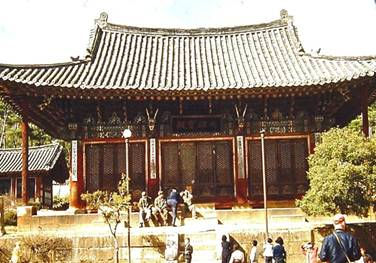
All was not missions, however. We found a Buddhist run orphanage some few miles away from the base, and several times we got the use of a jeep and went to visit and take candy and food to the children. There was a large temple, and burial sites of ancient Korean rulers, and we took lots of pictures. The kids were shy, but candy does help.
We had to be careful to respect the burial sites, but the area was surrounded with ancient statues, and the people at the orphanage didn’t seem to mind us posing with them. One sign stated that one of the larger grave mounds was the tomb of a king. We assumed that the statues were probably meant to be guards over the tombs. Other diversions were the Officer’s Club and poker games in the Flight Quonset. The Club was fun. We drank a bit and we learned some pretty raunchy songs, which were sung in Squadron strength! Sometimes we got into a competition between squadrons as to who could "out sing" the others. These fun and games came to a sudden halt with the arrival of a new Wing C.O., who decreed that bawdy songs were banned from the "O-Club". This was in deference to the few nurses and Special Service girls who ran the enlisted service club. These women were well familiar with the words in these songs, and in fact had frequently joined us in singing them!!
From time to time we found out that we had suffered the loss of classmates. I can’t recall just when it happened, but a group of F-84s had to land at K-13, out of fuel after a really long mission way up North. They were being debriefed by our intelligence people and as one pilot came out he was nearly in tears and said," poor Willy, he was only about 30 feet away from me, his cockpit was in flames, and I couldn’t help him"!! I asked him if he was talking about Willy Suffern, and he said he was!! I was shocked-- Willy and I had gone through the whole training program together, and now he was gone! This picture shows Willy’s squadron mates taxiing in after the mission on which he was lost.
The list got a bit longer as time went by. Dan McKinney flew into the ground on the Suwon Range. Pat McPherson rolled over into a dive on a combat mission and continued rolling into the ground. Cecil Clyott, who was at Connally with us, was on a RTU mission over Haiju and his flight went through some puffy clouds. He just wasn’t there when the other planes emerged from the clouds. No radio calls, no sign of wreckage on the ground---nothing!! Most of our losses were guys in the F-84 outfits, but we suffered some too. Right after take-off from K-13 one day Garfield Guyer called out over the radio, "This thing’s gone ape shit!!" and burst into flames and crashed!! By the end the Korean conflict, of the 98 Americans in 52-B who graduated from Williams, we had lost nineteen men killed and three were POWs; this was in addition to the four we lost at Luke. Dave Henry, on a local flight from K-13, had engine problems, and successfully bailed-out.
After flying two missions on the first of November, I came down with a nasty cold and was grounded for four days, and didn’t fly for three more. Doc Leep fixed me up with some little green pills that almost knocked you out, and to help them along gave me some cough syrup that finished the job!! Cured me though!! The first mission after the cold was a napalm attack near Haiju. This was a good mission and flying so low over a target was exciting, and the "golf balls" were thick!!.
On the 11th we had another thrilling mission. A flight consisting of Hezzy Dunaway, Ward Schramm, John Mark, and I were standing JOC alert, not expecting to be launched, because the weather was really overcast. We were sent, however, and as was the custom as the first man to the runway, Hezzie took the lead. We joined up in tight formation immediately after takeoff and headed North through the clouds, getting vector direction from "Dentist", the radar controller north of Seoul. Schramm was number two, Mark was number three flying on Hezzy’s left wing, and I was number four on Marks left wing. Over the front lines the controller told Hezzy to enter a "port orbit". Hezzy replied, "Which way do you want me to turn?", so Mark told him, "Turn left, Hezzy". As Hezzy entered the orbit, he reduced airspeed and I was having a tough time holding position, so I slid over into the "slot" behind Hezzy. Almost immediately, Schramm called out," My tips aren’t feeding and I’m low on fuel". At almost the same instant, Hezzy said, "Number 3, my gyros just tumbled, you take over", and he peeled off to the right and out of sight in the clouds!! I had to quickly slide over to Mark’s left wing to make room for Schramm. Mark called the controller and advised him of our problems, and the controller lined us up for a MPQ (radar controlled) drop, and cleared us to head south and climb to conserve fuel. We got up to about 20,000 feet, and started icing up!! The controller' advised us to descend, still heading south, and in a circling descent we broke out below the clouds at about 1,000 feet. Schramm, by now had red low fuel light on and had maybe five minutes of fuel left. We spotted a runway under construction just ahead--a new base, K-55!! Mark and I buzzed the runway, warning some trucks on it, and Schramm made a dead stick landing on the mud-covered runway!! Mark and I headed for K-13, and there we found Hezzy entering the pattern!! We had some "unkind words" with Hezzy after we landed!
The weather cleared the next day and a Group mission of forty-eight aircraft, lead by Col. Gray, was
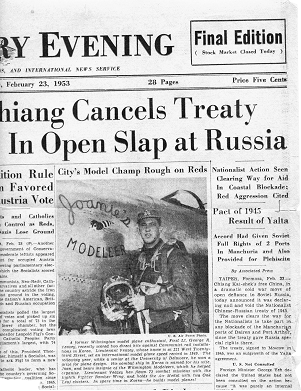
scheduled. The target was a command area at Kilsu-ri and we carried napalm. I flew element lead in 817, "Joanie’s Modeleer", newly assigned as "my" airplane (which entitled me to using the left nose door for "art").
About halfway to the target, Col. Gray edged over to my wing tip and motioned that his radios were out and for me to take over Group Lead!! I announced (using call signs only) over the radio that I was taking over the Group, and proceeded to the target, which we really plastered. That night we were listening to Pyongyang radio (they played great popular big band music) when they announced the latest list of "war criminals". The announcer said," Lt. George R. Veazey of the 36th Fighter Squadron, flying F-80 #817 took over Group Lead and led a napalm attack against an unarmed civilian village. He is from Wilmington, DE in the U.S. Lt. Veazey is advised that if he will be shot down he will be given a fair trial and be shot". It was painfully obvious that there were spies on our field!! Probably not connected, but later, an old papa san who swept up the main "war room" was taken out the front gate of the base by Korean Secret Police, and shot on the spot!!
After several additional missions, the 17th of November arrived. This would be a day I would remember for years to come. It was to be an easy mission, up to the Haiju and then beyond to a pre-briefed location. As I recall I was element lead, and when we arrived at the first checkpoint, the "butterfly lake", Therkleson, the flight lead, called for a power reduction to 90% rpm, as we had reached our normal cruise altitude of 12,000 feet. As I pulled back the throttle, I heard a "bang" and the airplane began shaking and I noticed a temperature overheat, saw reducing oil pressure, and correctly decided that I had a problem!! I retarded the throttle, called Therk that I had a problem, and zoomed up to about 14,000 feet as I reduced airspeed. I decided to pickle off the two 1000 pound bombs, and began to "squawk" "emergency" on the IFF and switched to "dog" (emergency) radio channel. I headed south and set up a "best glide" speed. I experimented with the throttle and found that I could get about 38% rpm without the shaking getting too bad. There had been an F-86 flight just above us when my engine acted up, so one aircraft had been assigned to "cap", or look after me. He reported that there were flames coming out my tailpipe, so I dove a bit, and he reported the flames were out. As my altitude decreased and I approached an island off the coast of South Korea, I disconnected everything and prepared to eject. I pulled the canopy eject "T- Handle", but nothing happened!! On the F-80C, the canopy had to be ejected before you could operate the ejection seat. There was a "ground release" capability, but there was a risk that the canopy could "dish" as it departed the aircraft and decapitate the pilot!! Then there was the problem just jumping out. I plugged the radio back in and described my problems to the radar controller. "Therk", who had been monitoring my situation, asked, "Veaz, what are you going to do??", and I replied, "I guess I’ll put it down". I jettisoned the tip tanks, pulled the electrical disconnect, and looked for a smooth spot on the mud flats.
By now I was near Inchon. The tides here surge in and out several miles, so there are large ditches in the mud flats. I set up for a smooth spot, but with the gear up and less drag, I overshot it and so just slowed up as best I could. As it turned out, I hit down, bounced over a big ditch in the tidal flats, and skidded to a stop.
My face hit the gun sight as I landed hard, but at least I was alive!! I pulled the canopy ground release and jumped out on the right wing. My F-86 "cap" made a couple of passes over me and seeing I was out on the wing, flew off. Almost immediately I saw a Marine Corps helicopter coming in and he settled down just off the wing tip. A crewman helped me aboard and hooked up a headset so that I could talk to the pilot. He asked if I was O.K., and where was my home base. When I told him K-13, he told me that he didn’t have enough fuel to take me there, and that, anyway, an Air Force chopper was on the way to get me. With that he returned me to the wing of my pretty beat up F-80.
The A.F. H-19 approached and landed about 50 feet away, and I had to slosh through the mud to get to it!! Safely on-board, we flew off to K-14 at Seoul, where I was de-briefed by intelligence and checked out by the medical personnel. While I was bruised a bit, they turned me loose, and I went to base ops to await a T-6 from K-13 that would take me home. Major Crockett later told me that after an investigation, the cable from the "T’ handle on the canopy ejection system was several inches too long, preventing it from actuating the release of the canopy.
An inspection of our aircraft found a number of aircraft with similar problems!! This would seem to explain why several of our pilots were lost after reporting attempting to bail out!!!
I rested the next day, but flew a close support mission in the Kumhwa area, which was about half way across the peninsula, on the 19th. From then until the end of November I flew an additional seven missions. By this time I qualified as a flight leader and flew lead on several missions. One mission was a special two aircraft flight to calibrate the radar controller equipment above Seoul. I forget who was with me on this mission, but we flew directly over the site and maintained a heading of 350 degrees. We checked in with the controller, "Dentist", every couple of minutes to insure that he was tracking us O.K. About 20 minutes after passing the site we had passed over the Haiju peninsula and for about 5 minutes the radio was silent. Then we got a reply, but it was a different voice!! I asked the controller about this, and he said, "Oh yes, I just replaced the man you were talking to." Suspicious, I asked him to "authenticate" by giving me the "code of the day", and he said to standby. After another 5 minutes without a reply I radioed that we were turning back, and he said, "No, no, you’re almost here!!". With that I said, "So long comrade!!" and we reversed our course. After about 10 minutes we heard "Dentist" calling us, the original voice!! He asked if we were O.K. and said we had been blanked out. Apparently the commies had overpowered his signal and tried to lure us north. We reported the events to Intelligence on our return.
Thanksgiving at K-13 was celebrated with the traditional turkey dinner, complete with stuffing and pumpkin pie for dessert.
We had earlier received the news that General Eisenhower had been elected President, and that during his campaign for election he stated that if elected, he would go to Korea and work to end the war. It was therefor not too surprising that for four days running (4, 5, and 6 December) we were to fly Squadron force "fighter sweeps" from Pyongyang to the coast and back at 35,000 feet as a deterrent for Migs to sweep south while the President- elect was visiting. Our poor dented and bent F-80s were hard pressed to perform well at that altitude, and flying with "max fifties" only compounded the problem. On one turn I fell, literally, out of the formation and it took miles to catch up. Other aircraft flew sweeps at other locations and we later heard that the Migs stayed home!! By this time I had been awarded my third Air Medal.
I flew five additional missions in December and by the end of the year had logged a total of sixty-four combat missions. Aside from one close support mission, the remainder of the month had us "working on the railroad" in the Haiju area. One of these missions was a JOC mission that took us to the edge of the "Kaesong Restricted Area", which was where the "peace" talks were being conducted. Pilots were forbidden to fly over the "restricted" area on pain of being court marshaled. Our target was boxcars in a ravine leading to a mountain "cave" where, presumably, an engine had taken refuge behind steel doors. While setting up to bomb the rail cars and well clear of the restricted area, we were subjected to flak from within the restricted area--so much for United Nations "fairness"!! As element lead I was third on the target. Ward Schramm was in forth, and he told me later that my two 1,000 # bombs bracketed the rails, exploded, and a boxcar was lifted up over a ball of fire and blew apart. The boxcars were loaded with ammo!!
Around this time I was serving as 36th Squadron Awards and Decorations Officer, and representative to the Group Awards and Decs. Committee. Major Loring, of the 35th Squadron was on a front lines mission in November and was hit by intense ground fire. He maneuvered his ‘80 to crash into the AA battery firing on his flight and destroyed it. We recommended a Silver Star award, but after it was reviewed in Seoul Headquarters, we were directed to write it up for a Congressional Medal of Honor. This award was finally made, and Loring AFB in Maine was named in his honor.
The weather in December and into the next year was bitterly cold. We had some snow, but nothing that stopped flying. We had no real hangers at K-13, only a sort of lean-to, so the line crews had to work virtually in the open. That didn’t prevent them from keeping our birds up and running. The line delivering oil from the 55 gallon drum outside the Quonset to the tent stoves froze up several times. The technique to un-freeze it was to hold cigarette lighters against the tubing until the oil started flowing again!!
Pilots occasionally were assigned duties other than flying. One such assignment was to operate runway control that involved operating a mobile radio unit from a jeep located at the approach end of the runway. There were two such units; one for the 51st Group, and our unit for the 8th Group. The duties included recording take-offs and landings, insuring landing gear was down, and providing advice in the event a pilot was experiencing difficulty. On December 22, I was operating runway control when one of our F-80s was taking off late in the day for a solo night bombing mission, something that had recently been started. I had just shut down the radio after the F-80 had been cleared for take-off by the tower. Watching him lift off about halfway down the runway, I saw a huge ball of fire and heard an explosion!! A Greek Air Force Gooney Bird loaded with litter patients had taken the runway and was hit by the F-80!! Captain John McGinnis from the 36th was the F-80 pilot. Thirteen people on the C-47 were killed, but the co-pilot survived. As a witness to the accident I was involved with the investigation, which was under the direction of Major Crockett. It was determined that the accident was due to a language mis-understanding. The Gooney Bird had requested permission to take the runway for a take-off from the runway mid-point. He was told to "Hold clear", which the pilot interpreted to mean "cleared to the runway". At the same time the F-80 was on the roll and collided with the C-47.
Christmas was a day off, and we had church services and another great meal. Joanie had sent several packages, including a small tree and a great photo of herself. On my birthday, the 30th, we had some excitement when "Bed Check Charley" flew over and tossed out hand grenades. The anti-aircraft guns opened up and the shrapnel from the shell bursts rained down on the metal roofs of the Quonset with a loud rattle. The shells bursting and the tracers going up made quite a display--great birthday celebration!!
About this time I got another present--a "spot" promotion to First Lieutenant. These promotions were temporary and were granted to those who had performed in combat in an exemplary manner. Time spent in a spot promotion counted double towards confirmation of the promotion, which usually took 18 months. In addition I was given my third Air Medal for completing 50 missions. I also won a Leica camera in a Red Cross raffle as another Christmas present!
1953 started out with more rail cutting missions, generally in the Choeryong and Haeju areas, and I flew lead on several of them. This was part of a continuing effort to disrupt the movement of supplies from the North to the front lines. The photo at left is a recce photo of a typical result of a mission. The year started on a sad note, however, when Lt. Glass was lost flying my 817 airplane. We had been having some trouble with it for several weeks as it would frequently develop engine surges. My crew chief, "Woodie", worked on it day and night, and had flown a couple of test flights and missions after he worked on it. I even helped him with some work on the airplane. I was on the flight line when the flight returned and Glass’s loss was reported. Woodie was in tears, because he thought that maybe he had done something wrong, but the report was that Glass had been hit and had gone down as a result. I did what I could to reassure him.
On the 12th and 13th of January the entire Fifth Air Force flew maximum effort strikes against the bridges at Sinanju. Two missions were flown on each of the days; one in the morning out of the East and one out of the West in the afternoon in order to come in out of the sun. Where the Chong Chong River passes through Sinanju the Commies had constructed a maze of rail and road bridges, many with the rails or road just below the water surface in order to make them difficult to spot from the air. These massive missions were designed to knock out these bridges and curtail passage of supplies to the south. The reece photo at right shows the multiple bridges across the river.
The bridges were protected by a dense concentration of anti-aircraft guns and the approaches were similarly protected. After the missions, one of our 36th pilots, who had flown on the famous Ploesti oil refinery raids in WWII, stated that the flak over Sinanju was heavier. The situation was complicated by the fact that, because of the shear numbers of aircraft, the approaches were predictable and the guns were aimed and ready, which made avoiding them pretty difficult.
On the first mission, a morning mission, I was assigned to "flak suppression" and carried two 1,000-pound bombs with "VT" (radar activated when a return of 16 feet was received) fuses, which were dangerous to carry, because if they were not properly mounted could activate before release and explode when they were dropped!! They were intended to keep the gunners heads down so the other aircraft could concentrate on the bridges themselves.
As we approached Sinanju, there was a "block" of black flak explosions about 2,000 feet deep and about a mile in length right on our flight path and we had to fly right through it!! Luckily, no one was hit and we proceeded to the target. When we rolled in from about 12,000 feet, the flak, both heavy and golf balls, was intense. I dropped my bombs from about 3,000 feet on my assigned target area and continued to dive, pulling out at less than 200 feet and doing over 450 miles per hour!! I dropped down to about 50 feet right down the center of the river and then a burst of black flak appeared directly ahead!! I broke left and another burst ahead; broke an immediate right and another burst!! It was obvious that there was a 88mm radar ranging gun tracking me from the shore!! I continued to weave until almost the mouth of the river and then zoomed up to try to find the rest of the flight. Luck was with me and I was able to join up for the trip home. Many years later at one of our "52-B Reunions", Rog Warren would tell me that he was shot down on this mission and before he was captured was in a rubber boat in the middle of the river with blocks of ice all around when he saw an F-80 with red fin stripes going "like a bat out of hell and dodging heavy flak"---we decided that it must have been me!!
The next day I again flew on the morning mission but dropped directly on the bridges. It was obvious that the flak suppression and direct bombing had reduced the number of guns that defended the area, for the flak was noticeably less than on the previous day. The post mission reports confirmed that we had delivered an effective blow to the enemy’s ability to get supplies over the river.
On the 14th I flew what would become my final combat mission. About twenty minutes into the flight I sensed a suspicious vibration in the aircraft, so I dropped my bombs and returned to K-13. Maintenance checked out the bird, and could not find a problem. The C.O. questioned why I returned early, and when I explained, he decided that maybe I needed a rest and sent me on R&R to Tokyo. While there I bought Joanie a string of Mikimoto pearls, and managed to call home. I had a good time, ate a lot of good food, and relaxed. The picture at right (sic. below) shows me in front of the Imperial Palace.
Upon returning to K-13 there was news of some changes--the 8th Group would get F-86s and the 36th would get them first!! There were conditions, however, as to who would get to fly the new aircraft. Pilots with fewer than 50 missions by January 31st would automatically be checked-out. Those with more than 50 missions could request checkout and would have to fly an additional 100 missions in addition to those already flown. If a pilot had more than 50 missions and did not sign on for the additional missions, he could elect to fly with another squadron still flying F-80s, or, could qualify to go home!! My C.O. offered me a second option. He told me that there were several temporary assignments for which he needed an experienced pilot to fill, and since I had performed so well and had a spot promotion, this meant I could confirm the promotion before returning home, thus helping with future promotions. At the C.O.’s urging, I agreed to this course of action.
The assignments included operating runway control, Tower Officer, Airdrome Officer, and other such duties. Tower Officer was a similar assignment to that of runway control, except that you operated from the base control tower. Airdrome Officer had you working with the Base Operations Officer logging transient flights and coordination of such flights with normal fighter operations.
The members of 52-B received the bad news in February that Rog Warren had been shot down during the raids on the bridges at Sinanju in January. I wrote and told Joanie about it, because I knew that she had written to Rog several times, and I didn’t want her to find out by way of a returned letter.
On February 16th I was acting as Airdrome Officer and the Base Ops Officer and I were monitoring landing flights from a weapons carrier just off the runway and about two-thirds down the strip. A squadron of Marine Corps F-9F Panther Jets called in for permission to land as they had a plane with severe battle damage in their formation and he could not make it to their home base at K-6, farther south of K-13. Given permission, we saw the damaged plane, streaming smoke and vapor, cross east to west over the runway. As he passed over the 51st area a piece of the plane blew off. Turning on base leg we could see fire and smoke billowing from the bottom of the airplane. The F-9F bellied onto and skidded down the runway. The pilot jettisoned his canopy and as he passed by our position the nose of the aircraft skewed to the right so that it’s 20mm cannons passed through us. We jumped into the "beater" and sped off to where the F-9F had skidded to a stop. We jumped up on the wing of the jet and helped the pilot out and took him to the "beater". The fire engines and rescue crew arrived and put out the burning F-9F. Taking the pilot to the Base Hospital, we discovered that he was none other than Ted Williams, the famous Boston Red Sox baseball player. After he was checked out and found to be O.K. by the doctors, we took him to Base Ops to await transport back to K-6. It was his first combat mission!!





The word spread throughout the base and the G.I.’s gathered around Base Ops, and Williams signed some autographs and posed for photos. I had an opportunity to talk to Williams at length until a Marine Goony Bird arrived to take him to their base. He was quite bitter about having been recalled to active duty. He said that he had finished pilot training near the end of WW2 and left the Corps to resume playing baseball and had no idea that he was subject to recall. In 1951, he was at the peak of his career when he received the notice to report to Cherry Point NAS for jet upgrading for 6 weeks and then to Korea. Williams thought that he had been singled out because he had a high profile, and said that Jerry Coleman, another famous ball player had also been recalled in that manner. I took several pictures of him before he left K-13.
Years later, I found out that Ted Williams was flying wing on John Glenn, who in later years became an astronaut and U.S. Senator. Williams’ squadron mates parked on our ramp for a bit. It sure looked funny to see their wings folded and sitting in a row!
Four days later, 20 February, I traveled by truck to the Suwon Gunnery Range to take over as Officer in Control. The truck passengers included a munitions man, a radio operator and me. We also had food supplies--the K-rations we would eat for the next week. On the way, we passed through a small Korean village where we found a crowd in the village square. There we saw three persons bound and on their knees with a stick with Korean writing up their backs. Korean National Police stood behind them, and shot them in the head!! We got out of there as soon as we could!!
Arriving at the Quonset serving as the control station for the range at 5 pm, we began to set up shop for flights arriving the next day to use the range. Flights would contact us by radio as they approached and we would coordinate their use of the range. We had about eight flights use the range on the first day and it was interesting to see the bombs and rockets explode from the ground. The next day our first flight to use the range arrived about 10:30 am. What happened next is best described in the report I filed after my time at the range was completed.
1. Control of the Suwon Gunnery Range was assumed by this officer at 1700 I, 20 February, 1953, and was relinquished at 1600 I, 27 February, 1953.
2. A flight of four (4) F-80 type aircraft, call sign "Vodka Yoke", was using the "big rock" target for napalm and rocket practice starting at 1035 I, 22 February, 1953, when, at 1050 I, Yoke two (2) was seen to crash into the water west of the 'big rock" while turning onto a south downwind leg. This officer visited the scene forty minutes after the crash in a helicopter, but the tide was in and the only sign of the crash was a large oil slick approximately one (1) mile west of the "big rock". At the next low tide that afternoon, personnel from K-13 Air Base searched the mud flats on foot, but could not locate the wreckage. No further sign or the wreckage was seen until 0815 I, 24 February, when this officer, in a helicopter, call sign "Pedro Dog", located the wreckage at a point three quarters of a mile on a heading of three hundred and thirty (330) degrees from the "big rock". All visible wreckage was in water approximately four (4) feet deep and tracks made by the local Koreans were noted at the water’s edge. 8th Fighter Bomber Group Combat Operations was immediately notified and guards were requested for the wreckage. No Koreans visited the scene during the evening low tide. When the guard requested did not appear, Airman Third Class Edward Hashem was ordered to commandeer a Korean boat from the village of Koon-ni, and, from 0400 I to 1000 I, 25 February, stood guard at the scene. Even though Airman Hashem expended over sixty (60) rounds of carbine ammunition to warn the Koreans away, he was unable to keep them from the wreckage. This officer arrived on the scene at 0800 I and, with the aid of Airman Hashem, was able to recover all the machine guns found, a parachute, a dinghy cover, and portions of the deceased pilot's body. The Koreans made off with virtually all of the wreckage of the aircraft. One (1) Korean boy stated that he saw the aircraft strike the water in a left bank, hitting first on the left tip. The remains of the pilot and the other items recovered were turned over to Lieutenant Jones of the 8th Medical Group the afternoon of 25 February 1953."
The pilot who was killed was Lt. Allen Tarr, a member of the 80th Squadron going through RTU. What I didn’t say in my report was that to insure the Koreans help in recovering the pilot’s remains, I had to hold my cocked .45 pistol to the village Head Man’s head until he agreed to help!!
I often wondered what my reaction would be seeing, much less picking up, mangled body parts resulting from an aircraft crash. Surprisingly, I was too busy to think much about it while recovering the pilot’s parts, but I sure thought a lot about it later. As part of the accident investigation of the crash on the range, I had another helicopter ride to the crash site, but this time I rode in the cockpit, not the cargo compartment as before. The pilot let me handle the controls--lets just say that I would need a lot of practice in order to become a helo.
When I returned from the gunnery range Icaught up with my mail. Joanie had sent me a copy of the Journal-Every Eveningfront page for February 23rd and there was my picture with the nose art on 817. The picture had been taken in December and had made its way through the Air Force public relations system to Wilmington.
The rest of my stay at K-13 was uneventful. I got my flying time in the Squadron T-Bird and also in the Wing C-47 on a trip back to Itazuki, Japan, our rear echelon base. I ran runway control and had the Tower Officer duty while awaiting orders to go home. I also heard that Sy Simonsen had been shot down in late March, which put a damper on my happiness at the prospect of going home.
In March, the new F-86s for the 36th Squadron started to arrive. The red stripes appeared on the vertical stabs, and checkouts began. The picture shows one of the new "birds" having it’s guns aligned.
On April 7th, the "word" was that the orders for Schramm, Brady, Henry and me, all of the 36th Squadron, were to be released the next day. I had already packed all my belongings and had turned in all my flight gear, except for a flight suit, while keeping out my older blue uniform to wear home. It was tradition that departing pilots throw a champagne party for those remaining, with each departing pilot providing two bottles of champagne. (Champagne was cheap--about $2.00 per bottle). After the dinner meal, we gathered at the O’Club for the party. The eight bottles went very quickly, so everyone chipped in and kept the bottles coming!! By the time the party was over--38 bottles had been bought!! We sang all the "forbidden" dirty songs, the fighter pilot songs, and just had a real blast. The next morning was a disaster--what a hangover!! Then we found out that the orders were delayed for a day!! That night we partied again, but not as hard as we had the night before.
Finally, on the morning of the 9th of April, 1953, I said "Good-bye" to K-13 and was flown to "Feamcom Area B" outside of Tokyo for processing home and next assignment. In spite of promises that as combat veterans we would get fighter squadron assignments in the States, we all seemed to get Training Command orders. It was back to James Connally AFB in Waco, TX for me to be an instructor in Advanced Pilot Training.
The four of us from the 36th went in to Tokyo together and stayed at a Japanese hotel together for several days while waiting for a departure date. Shopping, sightseeing and eating good food took up the time until our scheduled departure. We left Japan on April 17th.
It was a bit of a thrill when we made a night landing on Wake Island!! Totally black outside the DC-6--then a dim light on a stick in the water--and finally the tire screech as we touched down!! A short stop, and on to Honolulu. Another short stop and we were on our way to Travis A.F.B. in California. I had already purchased a ticket on commercial air from San Francisco to the East Coast, so when the pilot of the charter DC-6 offered a hop to the San Francisco airport, I grabbed it!! At the airport I took the first flight east - destination Washington, DC. I sent Joanie a telegram saying, " Suggest you set an extra plate for Sunday lunch!!"
Arriving in Washington in the morning of April 19th, 1953, I took a cab to the rail station and the first available train to Wilmington. When I got in a cab in Wilmington, I told the driver to take me home. I told him I was just back from Korea--his response was, "Oh really?--big deal!!" When I got to my parent’s home, everyone was there, and there was a big "Welcome Home" banner-and lots of tears and laughter. Parked in front of the house was Joanie’s and my new 1953 "Air Force blue" Chevy, which she had bought. Home at last!!!
Postscript: Ninety-eight (98) American Aviation Cadets and Student Officers, members of Class 52-B, received their wings on 22 March 1952. Four (4) of this number were killed in the course of Gunnery Training at Luke Air Force Base. Nineteen (19) lost their lives in the course of operations during the Korean War, and three (3) were Prisoners of War (POWs) for periods of up to seven (7) months. When I returned home I found that, other than friends and family, no one really had any appreciation for the sacrifices made by those who fought in Korea. To this day the Korean War is known as "The Forgotten War".